
Hydraulic Filter Element Guide 2026: Return, Suction and Pressure Lines
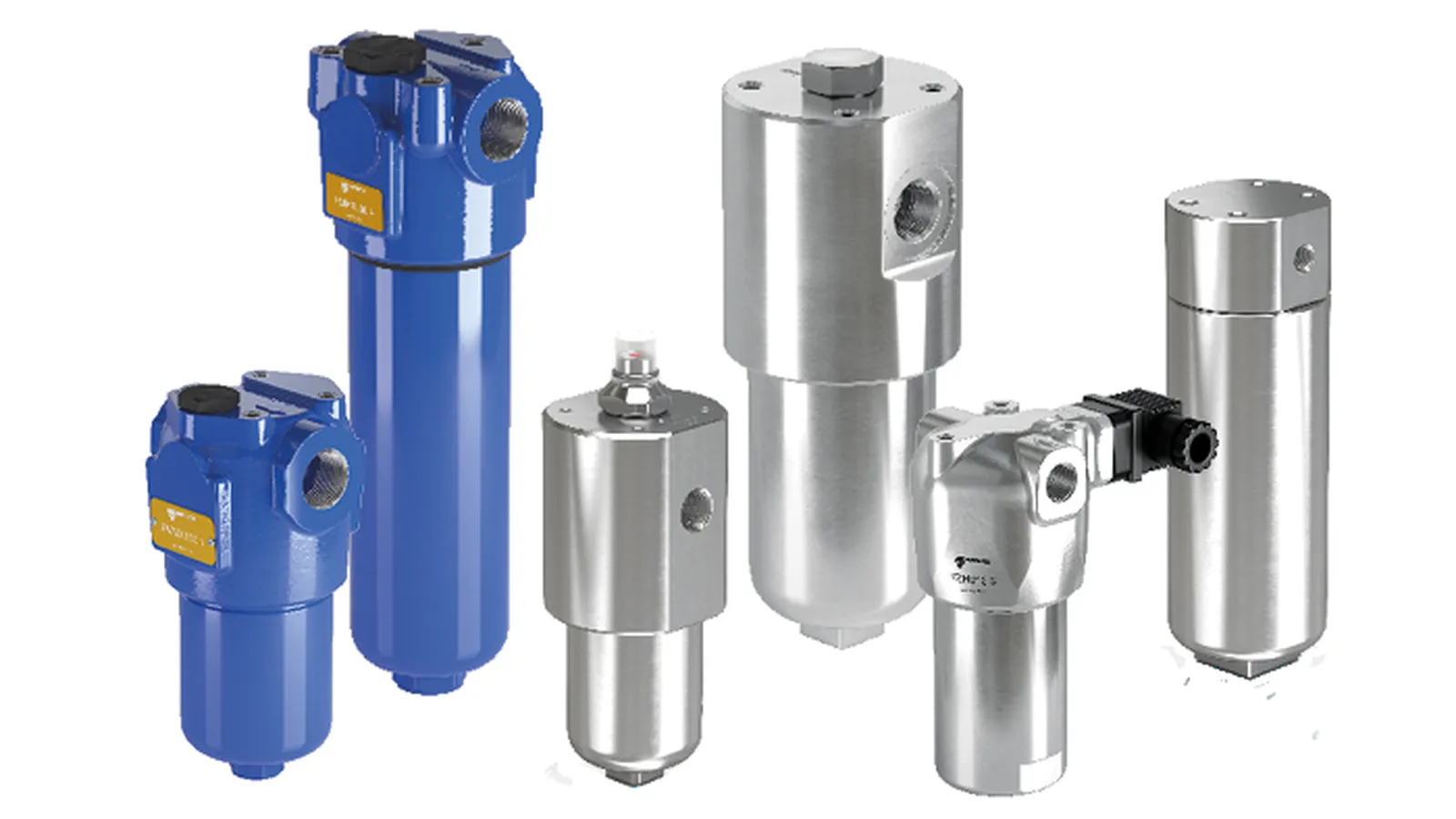
Table of Contents
A hydraulic excavator lost its swing drive on a Friday afternoon. The mechanic found a collapsed suction strainer and a pump housing scored beyond repair. The machine sat idle for three days while the parts order cleared. The repair bill crossed $18,000, and the strainer that caused it costs less than $40 as a replacement element.
Hydraulic filter elements are the cheapest insurance in any hydraulic system. A return, suction or pressure element costs tens of dollars. The pump, motor, valve or cylinder it protects costs hundreds of times more. Whether you search "hydraulic filter element", "hydraulic filter cartridge" or "hydraulic filter manufacturer", the question underneath is the same. Which element does this housing need, and how do I know it will fit and filter correctly? Buyers hunting for a "hydraulic filter element supplier" are usually one failed change-out away from switching brands. This guide covers the return, suction and pressure positions. It explains ISO 16889 beta ratings and ISO 4406 codes. It shows how to read cross-reference strings and when to change each element. Keep reading for more!
Key Facts at a Glance
- Definition — A hydraulic filter element is a replaceable cartridge that removes solid particles from hydraulic oil.
- Positions — Elements sit in three locations: return line, suction line and pressure line, each with a different rating.
- Rating — Performance is measured by beta ratio per ISO 16889, and system cleanliness by the ISO 4406 code.
- Media — Glass fiber is the standard hydraulic media; wire mesh suits coarse suction duty.
- Replacement — An interchange element is matched by outer diameter, inner diameter, length, thread and media class, which makes cross-brand fit possible.
What Is a Hydraulic Filter Element
A hydraulic filter element is the working core of a hydraulic filter. It sits inside a housing mounted on the tank, the pump inlet or the pressure line. Oil flows through the element under system pressure, and the media traps particles too large to pass. The oil that exits is cleaner than what entered.
You will hear several names for the same part. "Hydraulic filter element", "hydraulic filter cartridge" and "oil filter cartridge" describe the same component. A "suction filter element" protects the pump inlet. A "return filter element" cleans oil heading back to the tank. A pressure element cleans oil leaving the pump. They all share one job: stop abrasive particles before they reach expensive components.
Three dimensions decide whether an element fits your housing: outer diameter, inner diameter and overall length. Thread type, seal style and bypass configuration matter too. If any dimension is wrong, the element will not seat properly, and unfiltered oil will bypass it entirely. A rubber seal that is the wrong size leaks, and a leak on the suction side pulls air into the system.
Return, Suction & Pressure Lines
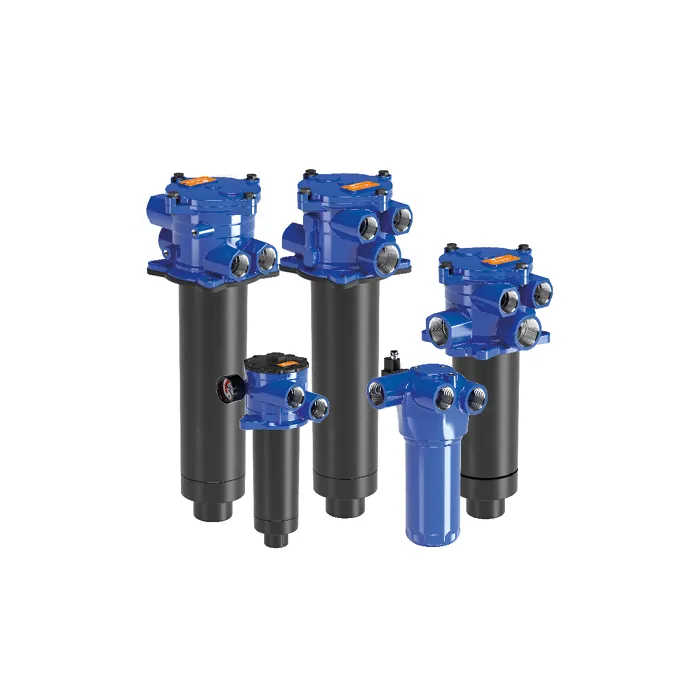
Every hydraulic circuit filters at three points. Each position has a different job, a different rating and a different change schedule. Mixing them up is the most common sourcing error we see.
1. Return line elements
A return filter element cleans oil flowing back to the tank from actuators. It protects the tank and everything downstream, which is effectively the whole system. Return elements run fine ratings, typically 10 to 25 micron with a beta ratio of 200 or higher. They carry the largest dirt load of the three positions.
2. Suction line elements
A suction filter element sits between the tank and the pump. It is the last line of defense before the pump, so it must be coarse enough to avoid starving the inlet. Typical ratings run 25 to 125 micron. A wire mesh hydraulic filter element is the classic suction strainer design, because mesh is cheap, cleanable and low in pressure drop.
3. Pressure line elements
A pressure element sits downstream of the pump and protects valves, cylinders and servo controls. High pressure filters see full system pressure, commonly up to 420 bar (typical). Ratings run fine, typically 3 to 10 micron glass fiber. A high pressure hydraulic filter that collapses dumps its dirt straight into the most sensitive part of the circuit.
| Position | Protects | Typical rating | Typical change |
|---|---|---|---|
| Return | Tank and all components | 10 – 25 µm, βx(c) ≥ 200 | 500 – 1,000 hours |
| Suction | The pump itself | 25 – 125 µm wire mesh | 250 – 500 hours or vacuum check |
| Pressure | Valves, cylinders, servo | 3 – 10 µm glass fiber | 1,000 – 2,000 hours or ΔP |
Return elements catch the bulk of the dirt. Suction elements protect the pump from tank debris. Pressure elements protect the precision parts. A balanced system runs all three; a cheap system runs only a return filter and pays for it later.
How a Hydraulic Filter Element Works
Filtration happens in two ways: surface filtration and depth filtration. Surface filtration catches particles on the face of the media, like a sieve. Depth filtration traps particles inside the thickness of the media, like a sponge that stops dirt.
Most hydraulic elements use both. A pleated glass fiber element catches large particles on the surface while smaller ones lodge in the media depth. This layered approach gives better dirt-holding capacity than either mechanism alone.
Three numbers describe any element:
- Micron rating — the particle size the media is designed to remove
- Beta ratio — how efficiently it removes particles of that size
- Pressure drop — the flow resistance the media adds, measured across the element
Pressure drop matters more than most buyers realize. An element that is too fine for the flow starves the pump. An element that is too coarse lets damaging particles through. The right element balances efficiency against flow resistance for your operating pressure and flow.
Every hydraulic filter also has a bypass valve. When the element plugs, the valve opens so oil still flows, protecting the pump from starvation. Bypassed oil is unfiltered oil, so a bypassed element must be changed immediately. A differential pressure indicator on the housing tells you when.
Glass Fiber & Other Media Types
The media does the work, so media choice is the first decision. Five media types cover nearly all hydraulic applications:
1. Glass fiber media
Glass fiber is the standard for hydraulic and lubrication filtration. It removes particles in the 1 to 10 micron range at high efficiency, with beta ratings of 200 or 1000 typical. It is the default for return and pressure elements because it combines fine filtration with long life. A high pressure filter element DML industrial filter element supplier catalogs group housings by port size, but every family runs glass fiber at its core.
2. Wire mesh and synthetic media
Wire mesh is a woven metal screen used mainly for suction strainers. It is coarse, strong and cleanable, which is why a wire mesh hydraulic filter element keeps showing up on pump inlets. Synthetic media resists chemicals and moisture better than paper, and is common in mobile machines that see water in the oil.
3. Cellulose and depth media
Cellulose elements are the economy choice. They filter adequately at 10 to 25 micron, cost little, and suit light-duty circuits. Depth media, such as melt-blown polyester, traps dirt through its thickness and holds more total contamination. Neither matches glass fiber for fine, efficient filtration, so they are rare in critical pressure lines.
| Media | Typical rating | Best for | Notes |
|---|---|---|---|
| Glass fiber | 1 – 10 µm | Return and pressure lines | High efficiency; βx(c) 200 or 1000 typical |
| Wire mesh | 25 – 125 µm | Suction strainers | Cleanable; low pressure drop |
| Synthetic | 5 – 25 µm | Mobile and wet systems | Water resistant; good flow |
| Cellulose | 10 – 25 µm | Light industrial circuits | Lowest cost; short life |
If the OEM manual specifies glass fiber, do not swap in cellulose to save money. The cleanliness level of the whole system changes, and the cost shows up later as pump wear.
Micron Ratings & ISO 16889 Beta
A micron is one-millionth of a meter. A human hair is about 70 to 100 micron thick. A particle that damages a hydraulic pump is typically in the 3 to 15 micron range, far too small to see.
1. Nominal vs absolute ratings
Micron ratings come in two flavors: nominal and absolute. Nominal means the media removes most particles above the stated size, with no strict efficiency guarantee. Absolute means the largest pore is capped at that size, tested per ISO 16889 or a bubble point standard. If a data sheet does not say which applies, ask. Many elements quote a nominal number that flatters the real performance.
2. Beta ratios in practice
The beta ratio is the honest way to compare elements. It is written as βx(c), where x is the particle size in micron. A filter with β10(c) = 200 passes, by definition, 1 particle for every 200 it captures at the 10 micron size. That is 99.5% removal efficiency. The table below shows the common classes.
| Beta ratio | Removal efficiency | Typical use |
|---|---|---|
| βx(c) = 75 | 98.7% | General hydraulic filtration |
| βx(c) = 200 | 99.5% | Standard industrial hydraulic |
| βx(c) = 1000 | 99.9% | Servo valves and high-value systems |
ISO 16889 is the multi-pass test standard that produces beta ratios you can compare across brands. An element rated βx(c) = 200 by one hydraulic filter manufacturer should perform like a 200-rated element from another. That holds only when both test per ISO 16889. When a supplier quotes a beta ratio without the test standard, treat the number with caution. Typical values shown; confirm the test standard on the data sheet.
ISO 4406 Cleanliness Codes
Beta ratios describe the filter. The ISO 4406 code describes the oil. The code tells you how many particles are in each milliliter of oil at three size channels. It is the language maintenance teams use to set targets and judge filter performance.
1. How the code works
The code looks like 22/18/13. The three numbers count particles equal to or larger than 4 µm, 6 µm and 14 µm per milliliter. Each number is a code, not a raw count. A code of 22 means roughly 1,300 to 2,500 particles per milliliter at that channel. Higher numbers mean dirtier oil.
2. Target codes by system
Targets depend on component sensitivity. A rough mobile excavator can run a looser code than a servo-controlled machine. Typical targets are shown below; always follow the OEM recommendation for your equipment.
| System type | Typical target (ISO 4406) | Typical element |
|---|---|---|
| Mobile equipment | 22/18/13 | 10 µm return, 25 µm suction |
| Industrial hydraulics | 20/17/14 | 10 µm glass fiber |
| Servo and proportional | 17/15/12 | 3 µm high efficiency |
If your oil analysis returns a code two numbers higher than the target, the element is overdue or bypassing. Fix the filter first, then re-sample. Adding a finer element without fixing the bypass solves nothing.
Brand Compatibility & Cross-Reference Fit
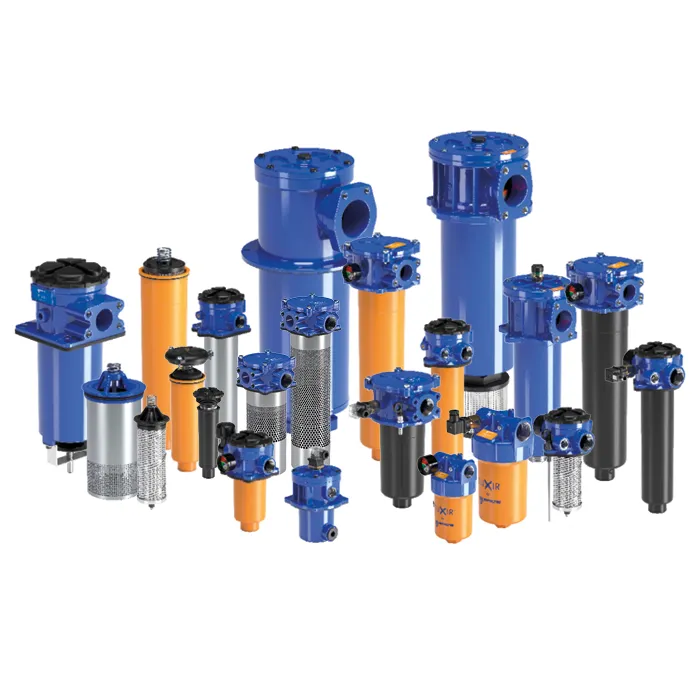
Replacement elements are big business because every installed filter eventually needs a new element. The market splits into two routes: buy the original brand, or buy an interchange element matched to the original dimensions. An interchange element is manufactured to the same outer diameter, inner diameter, length, thread and media class as the original. When done properly, it drops into the same housing, seals the same way, and filters to the same performance class.
Cross-reference tables start from the string stamped on the old element. That string may be a brand part number or a generic reference. The examples below are the kind of reference strings you will see in OEM catalogs; our interchange library matches each one to a dimension family.
| Reference string on the old element | Family and typical use |
|---|---|
| 0500D 010BH4HC Hydac hydraulic filter | Hydac-style return element, 10 – 25 µm typical |
| 0500D 010BH4HC Hydac pressure filter elements | Same family listed in newer catalogs |
| 0500D 010BH4HC Hydac pressure filter replacement | Same dimension family, replacement route |
| 852126DRG40 77682875 Mahle suction filter | Mahle-style suction strainer family |
| 852126DRG40 77682875 Mahle suction filter elements | Suction elements in the same family |
| 926835Q replacement return filter | Parker-style tank-top return family |
| 932627Q hydraulic filter replacement Parker | Parker-style pressure line family |
| 936601Q replacement Parker hydraulic filter | Same family, older catalog naming |
| 938373Q replacement Parker return filter | Return line variant of the family |
| High pressure filter housing DML 1 | Small port size, up to 60 L/min typical |
| High pressure filter housing DML 2 | Medium port size and flow |
| High pressure filter housing DML 3 | Medium-large port size |
| High pressure filter housing DML 4 | Large flow industrial circuits |
| High pressure filter housing DML 5 | Heavy mobile machine circuits |
| High pressure filter housing DML 6 | Largest DML-style footprint |
1. Hydac-style families
Hydac-style elements use a compact return format with metric threads. A stamped string such as 0500D 010BH4HC Hydac hydraulic filter appears in older catalogs. Newer lists call it 0500D 010BH4HC Hydac pressure filter elements. The 0500D 010BH4HC Hydac pressure filter replacement route maps to the same family.
2. Parker, Mahle and Pall families
Parker-style strings carry a Q suffix. G01954Q hydraulic filter replacement Parker 1 series is one example. 932627Q hydraulic filter replacement Parker charts list the same family. So do 936601Q replacement Parker hydraulic filter cross references and 938373Q replacement Parker return filter variants. Mahle-style suction elements include 852126DRG40 77682875 Mahle suction filter elements. Pall style families follow the same OD, ID and length rules. Filtrec hydraulic return filter catalogs use a similar numbering style from Italy. None of these strings is a PLEATPURE model; they are reference numbers we match to a dimension family.
3. Atlas Copco and mobile machines
Atlas Copco style elements for mobile compressors share the same seal and thread conventions as industrial hydraulic families. Long-tail search strings for the DML range include the following, and each resolves to the same housing family:
- hydraulic filter manufactuer DML interchange filter 2 — same family, alternate search wording
- hydraulic filter manufactuer DML interchange filter icon1 — same family, alternate search wording
- hydraulic filter manufactuer DML interchange filter icon2 — same family, alternate search wording
- hydraulic filter manufactuer DML interchange filter icon3 — same family, alternate search wording
High pressure filter manufacturer DML interchange filter lookups usually resolve faster than a brand search. Hydraulic filter element manufactuer DML interchange filter home pages list the families each supplier covers. Hydraulic filter element manufacturer DML landing page copy usually names the brands they cover. At PLEATPURE we manufacture cross-brand interchange elements verified against original dimensions, covering Hydac, Parker, Mahle, Pall, Filtrec, Atlas Copco and DML-style families among others. See our hydraulic filter cartridge range for the most common interchange families.
Replacement Intervals & Change Criteria
Change intervals depend on duty, not on the calendar alone. Three signals tell you when to change: operating hours, pressure drop and oil analysis.
1. Hour-based schedules
Hydraulic return elements typically run 500 to 1,000 operating hours. Suction elements change sooner, typically 250 to 500 hours, because they protect the pump directly. Pressure elements run 1,000 to 2,000 hours in clean systems. Mobile machines often change all elements at one service interval for simplicity.
2. Pressure-drop based change
The cheapest change policy is a fixed interval plus a pressure-drop check. Change when the differential pressure rises to 1.5 to 2 times the clean element reading, or when the bypass indicator trips (typical). A return filter running past its limit collapses or bursts, and the debris it held gets dumped into the tank.
3. Oil analysis based change
If you run oil analysis, the ISO 4406 code drives the schedule. When the code drifts above target, change the element even if the hour meter says no. When the code stays clean at the interval mark, extending the interval is reasonable, up to the OEM limit.
Servo circuits often use a high pressure filter 2-stage setup, with a coarse stage ahead of a fine stage. Change the coarse stage twice as often as the fine one. The fine element then lasts longer and the oil stays on target.
Installation & Change Procedure
A correct change takes minutes. A rushed change takes a pump. Follow the sequence below every time.
1. Before you start
Stop the machine and relieve system pressure. Clean the housing area with a cloth so no dirt falls in. Confirm the new element matches the old one: OD, ID, length, thread and seal. Check the O-rings for damage; a cracked seal bypasses the whole element.
2. The swap sequence
Remove the housing cover and lift out the old element. Wipe the housing interior. Fit new seals and lubricate them with clean oil. Insert the new element, seat it fully, and torque the cover to the housing spec. Do not overtighten a threaded bowl; the seal does the work, not the muscle.
3. First-run checks
Run the pump and watch the pressure gauges. Confirm the differential pressure returns to the clean reading. Check the housing for leaks. Reset the hour meter or note the change in the log. Dispose of the old element per local waste rules, since hydraulic oil is hazardous waste in most regions.
A sample-first approach costs one element and one hour of maintenance time. It prevents ordering a thousand units of an element that does not seat correctly in your housing. The sample order is the only way to be sure of fit before volume.
Buying Checklist
Before you place an order, run this checklist:
- Read or measure the old element — OD, ID, length, thread, seal type.
- Confirm the position — return, suction or pressure; each has a different rating.
- Confirm the media class — glass fiber for fine lines, wire mesh for suction, synthetic for wet systems.
- Confirm the micron rating — nominal or absolute, and the beta ratio if rated per ISO 16889.
- Check operating conditions — max pressure, temperature and flow must sit below the element rating.
- Know your housing — quote the housing brand and model, not just the element length.
- Ask about MOQ and lead time — stock families ship fast; custom media builds take longer.
When you choose a hydraulic filter element supplier, ask for the test certificate. A supplier that cannot show an ISO 16889 data sheet is quoting you a guess. A hydraulic filter element manufacturer that tests per standard can document beta ratio and dirt-holding capacity for every family.
Common Mistakes Buyers Make
- Buying by brand instead of by dimension — the stamp on the old element is not the spec. Measure it.
- Going finer than specified — a finer element raises pressure drop, shortens life and can starve the pump on the suction side.
- Ignoring the seal — a cracked O-ring or missing gasket lets unfiltered oil bypass the element.
- Stretching change intervals — a collapsed element costs more than the filters you skipped.
- Mixing media classes — swapping glass fiber for cellulose changes the cleanliness of the whole system.
- Forgetting the bypass — a bypassed element is a pipe, not a filter. Change it.
Each mistake shows up in the field as an expensive surprise: a failed pump, a scored cylinder, a rejected batch. All are avoidable with a spec sheet and a ruler.
How often should you change a hydraulic filter element
Return elements typically run 500 to 1,000 hours. Suction elements run 250 to 500 hours or until the vacuum gauge rises. Pressure elements run 1,000 to 2,000 hours in clean service (typical). The reliable rule is interval plus pressure drop: change on schedule, or sooner when the indicator says so.
The Bottom Line
A hydraulic filter element is a small, replaceable part with an outsized job: protect equipment that costs hundreds of times more than the element itself. Match the position to the housing, the media to the fluid, and the rating to the equipment spec. Change on a schedule plus pressure drop, never on memory alone. Buy replacement elements by dimension and media class, not by brand habit.
PLEATPURE manufactures glass fiber, wire mesh and synthetic hydraulic filter elements factory-direct, with cross-brand interchange fit verified against original dimensions. Every element is checked for dimension, seal integrity and media integrity before it ships, and volume buyers get a dedicated account manager and MOQ flexibility. Browse the full range or send us the reference string from your old element for a cross-reference quote.
NEXT STEP
Ready to Switch to Replacement Filter Cartridges?
Send us your element dimensions or part numbers — our team responds within 24 hours with pricing and lead time.
Written by
Ray ChanFiltration Buyer's Guide Author · Industrial Filter Cartridge Specialist. Ray helps global importers, distributors and maintenance teams source factory-direct replacement filter cartridges.